



The real challenge for businesses on social media isn’t the posting time it’s the content itself. A social media automation system fills this exact gap. Based on the business’s product and service information, it generates images, videos, text, and hashtags on its own, schedules them on a calendar, and publishes them to the platforms after approval.
Just imagine. It’s Friday afternoon. Your account has been quiet for three days, you don’t have a single image to share, the designer is working on something else, so you repost an old photo, thinking, “Let’s just put something up.” The same scenario plays out again the following week. That’s exactly why the Social Media Automation System comes to the rescue for you and your brand.
Artificial Intelligence Automation System for Social Media
What makes social media automation meaningful today is the artificial intelligence behind it. In the past, when people thought of automation, they only thought of rule-based tools like “share this post at this time.” These tools handled the scheduling, but humans still created the content. An AI-powered automation system for social media, however, flips this equation on its head. It takes over the creation process itself, leaving humans with the role of providing direction.
The role of artificial intelligence here isn’t limited to a single task. It operates as a unified system that generates visuals, edits short videos, writes text, selects hashtags, and ensures all of these elements are consistent with the brand’s voice. In other words, it brings together the tasks that a designer, an editor, and a copywriter would normally perform separately into a single system. This enables both speed and consistency at the same time, because there are no fluctuations in quality among the content produced through this single system.
How Does Artificial Intelligence Customize Content for a Brand?
For content generated by an AI system to be effective, it must be tailored to the brand. Simply generating random, visually appealing images is not enough. This is where the system undergoes a learning process. It first learns about the company’s products, industry, target audience, and brand voice, and then shapes every piece of content it generates based on this information.
Thanks to this learning process, the resulting content appears to come directly from that business. The products in the visuals remain consistent with the actual products, the language in the text sounds as if it came directly from the brand, and the selected topics are relevant to the industry. As the business grows and its product range expands, the system incorporates this new information into its own production logic. The result is a structure capable of single-handedly managing the business’s social media—one that never tires and never disrupts the flow.
The real challenge businesses face on social media isn’t the posting time—it’s what to post. A social media automation system fills this exact gap. Based on the business’s product and service information, it automatically generates images, videos, text, and hashtags. It schedules these posts on a calendar and publishes them to the platforms after approval.
Just imagine. It’s Friday afternoon. Your account has been quiet for three days, you don’t have a single image to share, the designer is working on something else, so you repost an old photo, thinking, “Let’s just put something up.” The same scenario plays out again the following week. That’s exactly why the Social Media Automation System comes to the rescue for you and your brand.

What Is a Social Media Automation System, and How Does It Work?
The perception of social media has changed over the years. These platforms are no longer simply places to share content; they have become living organisms, serving functions such as brand image and sales. Given the broad scope and purpose of social media, automation systems have naturally gained great importance. For this reason, the question “What is a social media automation system, and how does it work?” has become one that must be answered.
In the broadest sense, a social media automation system is software that creates and manages a business’s social media content from start to finish. The business introduces its product or service once, and the system then regularly creates content, schedules it, submits it for approval, and publishes it.
The key distinction here is this: the system doesn’t just share content—it actually creates the content itself, including images, videos, captions, and hashtags. In other words, it solves not the problem of “I have a post readywhen should I share it?” but rather the problem of “I don’t have any content to share.”
What Is the Difference Between Social Media Automation and a Content Planning Tool?
When it comes to automation, the first comparison is often made with content schedulers or agency services. The most important difference between these two concepts is the process and format of content creation. Most tools on the market are schedulers. You design the visuals, write the text, and the tool publishes it at 10:00 a.m. on Tuesday. It’s useful, but it doesn’t solve the hard part of the job because the hard part isn’t scheduling.
A social media automation system starts one step earlier in the process. It decides what to share, creates that content, and then schedules it. That’s the difference between filling an empty calendar and managing a full one. You can test this by asking: If you don’t upload any files, what does the tool you’re using share? If the answer is “nothing,” then you’re using a scheduling tool, not a content creation system.
How Does a Social Media Automation System Generate Content?
The system is great, but you need to fully understand it. How does a social media automation system generate content? This also requires a brief explanation. During setup, the only thing required of the business is to provide an initial profile. Providing accurate information is very important, because every piece of information here affects content generation. The rest operates as a repeating cycle. Below, we’ve broken down the steps of this cycle one by one.
How Do You Enter Brand and Product Information into the System?
The first step in the process is introducing the brand. The beginning is the most important and critical stage. The business logs into the dashboard and adds its products or services. For each product, a few images, a few lines of information, and details about the brand’s industry and what it does are sufficient. The system uses this information to understand who the brand is, what it sells, and who its target audience is.
This is a one-time step. You won’t need to touch it again unless you add a new product to the catalog. The initial setup takes about half an hour, and after that, the system can generate content based on this definition for months. The clearer your description, the more accurate the resulting content will be, so taking a little time at the beginning pays off exponentially later on.
How Does the System Find Content Ideas?
The question “What should I post this week?” is the one that disrupts content planning the most. This is where social media automation systems come into play. So, how does the system come up with content ideas? What are its benchmarks, criteria, or basis? The system derives content ideas, scenarios, and narrative angles specific to that business from the product and brand information entered. It identifies the topics on its own.
It doesn’t showcase the same product from the same angle every time. One post might focus on how to use the product, another on how it solves a problem, and yet another on a seasonal context. This way, the feed doesn’t become repetitive, and you don’t end up with that stagnant look where the same three images keep cycling. The burden of coming up with ideas is completely taken off your shoulders the only decision you have to make is whether to publish the content or not.
How Are Images and Videos Created for Social Media?
In the social media automation system we developed, let’s also explain “how are visuals and videos created for social media?” Let’s make it clear right away: the visuals and/or short videos produced are not stock photos. They consist of scenes featuring the business’s own products and brand. This is important because stock images make a brand look like any other, whereas every frame produced here looks like it belongs to that specific business.
Product content remains consistent across platforms. This is because everything is shaped based on the information provided by customers, as well as product images and details. The product image you shared in January matches the same product image you shared in March—there are no discrepancies in color or shape. The outputs can be delivered in the format social media platforms require, whether vertical or square. There’s no need for separate cropping for Reels or separate editing for the feed. The system completes a task that would take a designer days in just minutes—while maintaining the same high standard of quality.
Are Post Text, Titles, and Hashtags Generated Automatically?
The answer to this question is short and clear: “Yes.” The system automatically adds a description, an eye-catching headline, and hashtags relevant to the content beneath each image. All of these are generated to complement the image, so you don’t need to match them later.
There is a deliberate limit to the text of content generated by social media automation systems. There are no exaggerated claims. Phrases like “the best in Turkey” or “guaranteed results” not only erode the brand’s reputation over time but also create legal risks in certain industries. Guided by this awareness, the system writes in a measured and honest tone. This approach is crucial for brand safety, as a single false promise can undermine years of built-up trust.
How Do the Content Calendar and Automatic Sharing Work?
We could say this is actually the most well-known part. The content created is scheduled according to a calendar. That’s where it’s determined what will be posted on which day and how the posts will be rotated. Since regular posting is rewarded by the algorithm, maintaining this rhythm directly impacts the account’s visibility.
There are two options for publishing. You can view the content in the dashboard and approve it one by one, or, if you prefer, you can set it to publish fully automatically. Approved content is automatically posted to platforms like Instagram and YouTube. If you’d like, you can also download it and share it manually. In other words, even though the system operates automatically, control always remains with your business you decide how much you want to be involved.
What Is UGC Video Production, and Why Does It Increase Conversion Rates?
UGC (User-Generated Content), or user-style content, refers to videos that give the impression of a real person describing a product in their own words. One of the system’s distinct and powerful capabilities is its ability to produce this type of video.
A social media automation system is used to create a digital brand face tailored to the business. Whether the person is male or female, their age range, and appearance—all of these are determined based on the brand’s target audience. This face then consistently appears in videos showcasing the business’s products or services. It’s always the same person, as if they were the brand’s own spokesperson.
The reason this content works is simple. People watch the ad as an ad, but they listen to what a person is saying on camera as if it were a recommendation. The latter has both a higher watch time and a higher conversion rate. UGC videos are offered as a separate package; they can be added to an existing content package or purchased on their own.
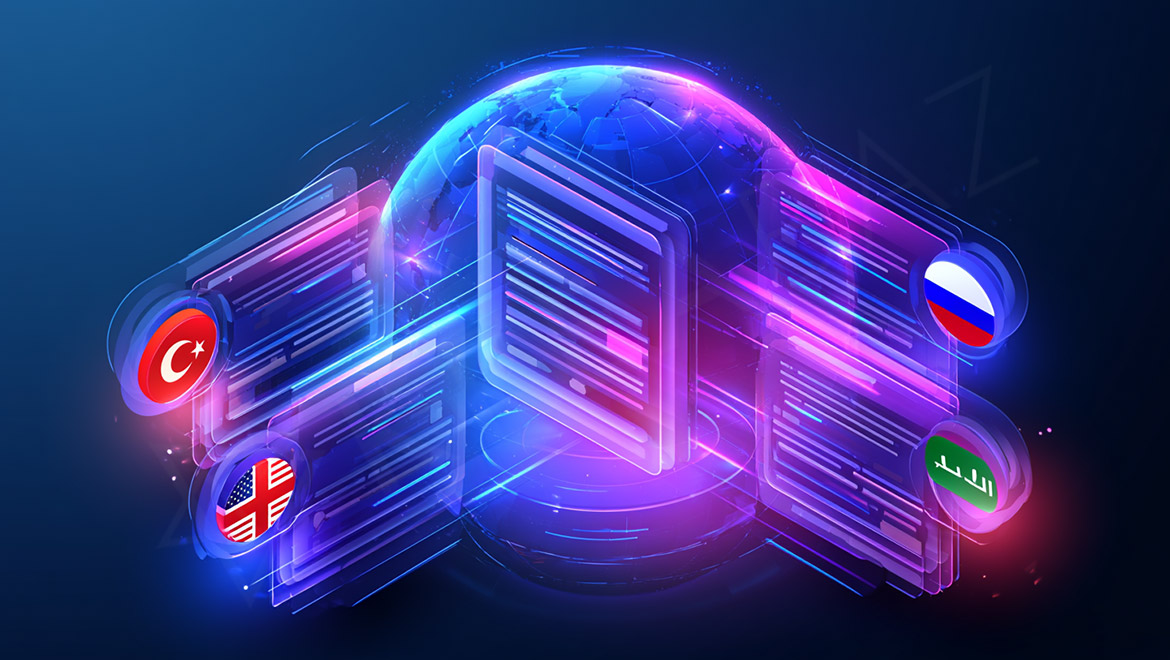
Can Artificial Intelligence Generate Multilingual Social Media Content?
Absolutely yes, the system can generate any content in different languages. For a business that exports or sells to different markets, language is a factor that multiplies content costs. Russian and Arabic versions of the same content normally mean separate translators, separate designs, and separate publishing schedules. Since this is a natural part of the production chain within the system, it doesn’t create an additional burden. This is the game-changer for businesses that have been considering expanding into international markets but have put it off due to the content workload.
At KREABAZ, we currently offer content in Turkish, English, Russian, and Arabic. When content is created, the text is available in all four languages at once.
Which Businesses Are Suited for Social Media Automation?
Perhaps one of the most frequently asked questions is this: “For which businesses is social media automation suitable?” This is actually a very reasonable question. After all, not every system works for every industry. Not every social media platform or advertising channel can be used for every industry. However, social media automation systems can generate content suitable for every brand and industry. The system works for both businesses that sell products and those that provide services. This is because it adapts the brand to each specific industry. Of course, the benefits may be more pronounced in some industries than others. Let’s take a look at a few different industries together.
Social Media Automation System for the Healthcare Sector
Clinics, dentists, aesthetic centers, and outpatient clinics are among the businesses that need to produce content regularly but lack the time to do so. Patient trust is largely built on visibility, and an inactive account does not inspire confidence. The Social Media Automation System organizes pre- and post-treatment stories, service promotions, and informative content into a consistent flow.
In this sector, it is also critical that the text be measured. In the healthcare sector, statements containing exaggerated promises and guarantees pose serious risks under advertising regulations and may even result in penalties. Since the system is already written in honest and measured language, it minimizes this risk from the outset. For clinics involved in medical tourism, multilingual content directly appeals to the influx of international patients.
Social Media Automation System for Restaurants and Cafes
In restaurants and cafes, content is an area that needs to be updated daily. Menus change, seasonal items are introduced, and promotions come and go and all of these require visuals. Manually creating new visuals every day is not sustainable for most businesses.
The system integrates menu items, daily specials, and promotions into a feed using well-designed visuals. Since appetizing visuals directly drive sales in this industry, the quality and consistency of these visuals are crucial. For establishments in tourist areas, content in four languages also helps reach international customers, as a restaurant that offers its menu in Russian or Arabic stands out to that audience.

Social Media Automation for E-Commerce and Online Stores
Social media automation for e-commerce and online stores is one of the areas that benefits most clearly from automation. It’s impossible for a store with hundreds of products to create separate content for each one manually. That’s why, in most stores, only a few best-selling products stand out, while the rest of the catalog goes unnoticed.
Since the system has no limits in terms of volume, it can display the entire catalog. Whether there are 10 products or 100, the content is presented in a similar format. When a new product is added, its description is automatically included in the feed. Multilingual content opens up new opportunities for stores that sell internationally, allowing the same product to be described across four markets at once.
Social Media Automation in the Real Estate Industry
In real estate, every listing actually represents a separate content need. The description, location, and standout features of every property in the portfolio should be shared regularly, because in this industry, buyers are often browsing social media. However, manually creating content for each listing is a heavy burden for agencies without support.
In the real estate sector, social media automation generates regular promotional content based on property listings and schedules it. In areas with high volumes of residential sales to foreign buyers, content in four languages is particularly valuable. A real estate agency that produces content in Russian and Arabic can reach buyers in those markets directly in their own languages an advantage that most competitors lack.
Social Media Automation in the Beauty and Personal Care Industry
Hair salons, beauty salons, and spa businesses rely heavily on visual content. Before-and-after photos, service promotions, and care tips directly influence customer decisions in this industry. But producing this content every day is simply too much to fit into a business owner’s already packed schedule.
In the beauty and personal care industry, social media automation takes on this burden by generating a steady stream of visuals from services and products. As in the healthcare sector, it is important to avoid exaggerated claims here as well; in particular, statements regarding aesthetic and personal care results should be kept moderate. The system’s honest language protects the business in this regard, both legally and in terms of its reputation.
Social Media Automation in Tourism and Hospitality
Social media is a channel that drives direct bookings for hotels, tour companies, and lodging businesses. However, this industry requires a high degree of visual content and, by its very nature, caters to a multilingual audience and when these two factors combine, the content workload multiplies.
The Social Media Automation System meets both of these needs simultaneously. While generating content related to accommodations, regions, and experiences with consistent visuals, it publishes the same content in four languages at once. Content in Russian, Arabic (or other languages to be added) directly translates into demand, given the high volume of tourists from these markets. While keeping a hotel’s social media active in four languages would normally require a large team, the system allows a single person to manage it independently. For these reasons, social media automation offers significant benefits in the tourism and hospitality industries.
Will Social Media Automation Replace Humans?
It’s worth making one thing clear. The B system doesn’t take the human element out of the equation. The decision to run a campaign is yours. Which product to highlight, when to start the seasonal sale, and the brand’s tone of voice these are all your decisions. The system doesn’t set the strategy; it executes it.
It’s the same old routine. That task that’s repeated every week the one that, if left undone, causes the account to go silent, and for which no one gives you a medal when it’s done. That’s the part that eats up the bulk of the time in social media management. Businesses that use this knowledge to their advantage get the most out of the system. They sit down once a month to set the direction, let the system handle the content creation, and get back to their core business.
How Do You Set Up a Social Media Automation System?
This is a highly complex process that involves the controlled interconnection of numerous equations. Many factors are involved in this process, such as selecting the right AI programs, writing the right prompts, setting up mechanisms to control the system, and adapting products to be compatible with the system before uploading them. The system is currently live and generating content for real businesses. Instagram and YouTube channels are active, and new capabilities including user-generated content (UGC) videos continue to be added.
Setup begins with your business showcasing its products once; the system takes care of the rest. If you’d like to see what kind of content flow the system can generate with your products, please contact us so we can demonstrate the system using your products.
KREABAZ Social Media Automation Systems
KREABAZ offers an automation system that creates social media content for businesses from start to finish. You introduce your product once, and the system generates your content from images to videos and from text to hashtags prepares it in four languages, schedules it, and publishes it upon your approval. With the UGC video package, you can also add a unique digital identity tailored to your brand. Feel free to contact us to see how the system works with your own products.